Sega Dreamcast · 1999
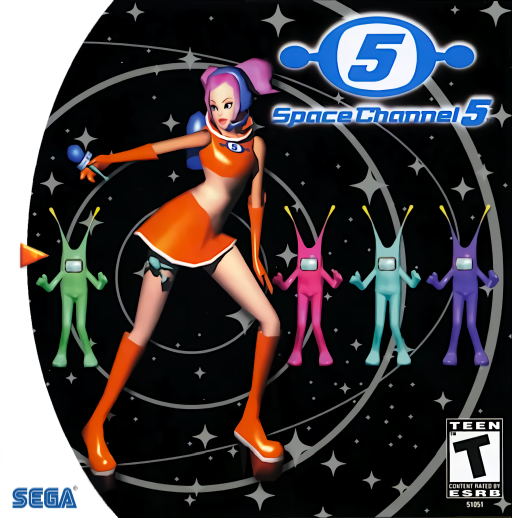
Space Channel 5
スペースチャンネル5
- Developer
- Sonic Team
- Publisher
- Sega
- Composer
- Naofumi Hataya
- Country
- 🇯🇵 Japan
- Series
- Space Channel 5
- Release year
- 1999
Standard · 🇯🇵 JP · CIB: 118,8% (Fri Apr 24 2026 00:00:00 GMT+0000 (Coordinated Universal Time)). Standard · 🇺🇸 US · CIB: 124% (Fri Apr 24 2026 00:00:00 GMT+0000 (Coordinated Universal Time)). Standard · 🇪🇺 EU · CIB: 157,4% (Fri Apr 24 2026 00:00:00 GMT+0000 (Coordinated Universal Time)).
Standard
| Región | SEALED | CIB | LOOSE |
|---|---|---|---|
| 🇯🇵 JP | €45.99 €39.09 – €52.89 | €19.30 €16.41 – €22.20 | €6.92 €5.88 – €7.96 |
| 🇺🇸 US | €48.76 €41.45 – €56.07 | €32.64 €27.74 – €37.54 | €26.18 €22.25 – €30.11 |
| 🇪🇺 EU | €81.07 €68.91 – €93.23 | €37.78 €32.11 – €43.45 | €15.47 €13.15 – €17.79 |
Prices show the median of recorded sales (source: eBay + Heritage auctions + PriceCharting aggregates, the same data that feeds your portfolio). Differences between regions reflect rarity: Japanese AES copies are typically 2–4× cheaper than their European equivalents because they had a much larger print run.
Description
Space Channel 5 is a 1999 music video game developed and published by Sega for the Dreamcast. It was later ported to the PlayStation 2 and Game Boy Advance. Following space-faring reporter Ulala as she investigates an alien invasion, players engage in rhythm-based combat where Ulala mimics the actions of rivals in time to musical tracks. The game was conceived by Tetsuya Mizuguchi, who was told to create something aimed at a female audience. Production lasted two years, with a staff of around 20 that included company veterans and newcomers to game development. The music, composed by Naofumi Hataya and Kenichi Tokoi, drew inspiration from big band music, including Ken Woodman's song "Mexican Flyer", which served as the game's theme song. The visual style was influenced by culture from the 1950s and 1960s and the later music videos of Peter Gabriel and Michael Jackson, the latter having a cameo appearance in the game. While the game was released to low sales, it received generally positive reviews; praise focused on its music-based gameplay and art direction, but it was also faulted for its short length and syncing issues with the graphics. The PS2 version met with similar praise,...
Source: Wikipedia · Read more
Releases
| Platform | Region | Date | Publisher |
|---|---|---|---|
| Sega Dreamcast | 🇯🇵 JP | 1999 | Sega |
| Sega Dreamcast | 🇺🇸 US | 1999 | Sega |
| Sega Dreamcast | 🇪🇺 EU | 1999 | Sega |